Voice artificial intelligence is turning everyday conversations into powerful digital tools. From smart speakers in our homes to virtual agents in contact centers and voice-enabled dashboards at work, voice artificial intelligence is changing the way businesses and people communicate. By using intelligent tools for call center teams and intelligent contact center tools improving agent productivity, organizations can make interactions smoother, faster, and more helpful for both customers and employees.
Voice AI also works closely with cloud computing services powered by artificial intelligence that help businesses process data quickly and make better decisions, allowing companies to respond faster to customer needs and market changes. Modern computer technology that combines AI for automation and smarter operations helps organizations save time, reduce mistakes, and improve overall efficiency. In marketing, digital marketing campaigns driven by AI for personalized content, customer targeting, and performance tracking help brands reach the right audience and improve engagement. For finance, AI-powered financial management and analysis tools for smarter investments, risk monitoring, and fraud prevention make it easier for organizations to manage money and plan for growth.
All these technologies come together to create an integrated AI-powered system for business operations, customer communication, and digital marketing strategies, making companies more data-driven, responsive, and competitive. Voice AI is more than a tool—it connects human communication with smart technology to create better experiences, faster solutions, and smarter decisions.
For organizations, this is far more than a novelty. When used strategically, voice AI can cut costs, unlock new revenue, personalize interactions at scale, and dramatically improve accessibility. For users, it feels like technology finally speaks their language.
Top Contact Center AI Solutions for Enhancing Customer Experience
Voice artificial intelligence is revolutionizing customer interactions, making call centers smarter, faster, and more efficient. Businesses looking to implement AI-powered contact center solutions need reliable platforms that integrate intelligent tools to improve agent productivity and deliver seamless customer experiences. Here’s a list of the top solutions in the market:
1. Bright Pattern – AI Contact Center Solutions
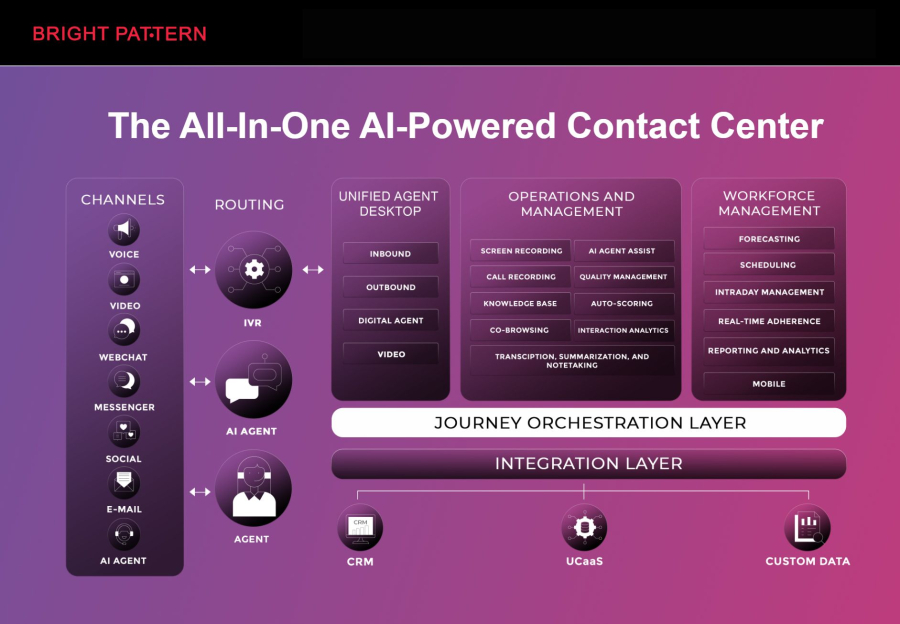
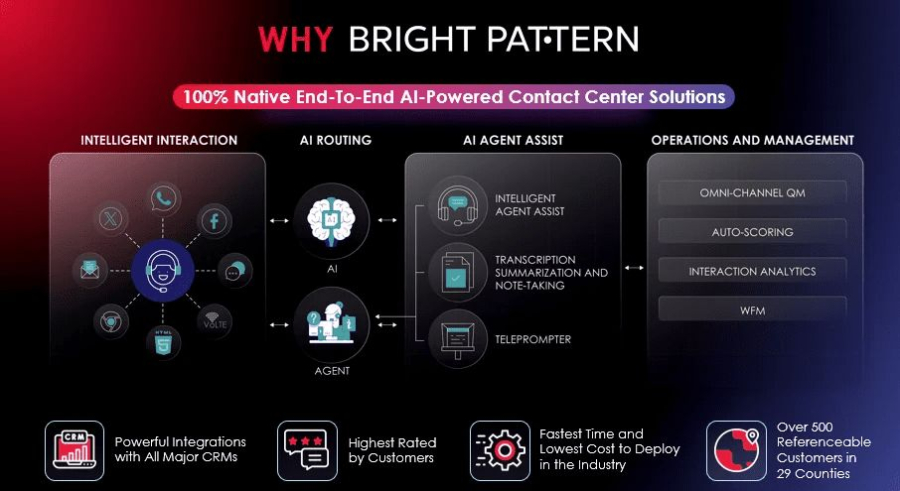
Bright Pattern is a leading provider of AI-driven contact center solutions, helping businesses streamline customer communication across multiple channels. Their platform leverages voice artificial intelligence to enhance agent performance, automate workflows, and deliver personalized customer experiences.
Key features of Bright Pattern include:
- Omnichannel routing for voice, chat, email, and social media interactions
- Intelligent virtual agents to handle routine inquiries
- Advanced analytics for performance tracking and insights
- Integration with CRM and other business tools
- Real-time coaching and assistance for agents
With Bright Pattern, companies can reduce call handling times, improve customer satisfaction, and empower agents with intelligent tools for call center teams.
2. Five9 – Cloud Contact Center Solutions
Five9 provides cloud-based contact center software with AI capabilities for improved customer interactions and operational efficiency. Their platform offers AI-powered chatbots, predictive dialing, and analytics to optimize performance.
3. Genesys Cloud CX – AI Customer Experience Platform
Genesys Cloud CX uses AI to deliver personalized customer experiences, predictive routing, and workforce optimization. Their tools allow organizations to integrate voice AI and digital channels seamlessly.
4. Talkdesk – AI-Powered Customer Service
Talkdesk combines AI, automation, and analytics to enhance agent productivity and customer satisfaction. Their AI tools assist with call routing, sentiment analysis, and workflow automation.
5. NICE inContact – Intelligent Cloud Contact Center
NICE inContact offers AI-enabled solutions for workforce optimization, customer engagement, and omnichannel communication, helping businesses improve operational efficiency.
6. Cisco Contact Center – AI Solutions for Enterprise
Cisco Contact Center integrates AI for predictive routing, virtual agents, and real-time analytics, allowing enterprises to scale and enhance customer interactions.
7. 8x8 Contact Center – Cloud Communication with AI
8x8 provides cloud contact center solutions with AI-driven voice analytics, customer journey tracking, and automated interactions to improve both agent and customer experience.
8. Vonage Contact Center – AI-Enhanced Communication
Vonage uses AI to automate routine tasks, enhance call routing, and deliver actionable insights that improve contact center efficiency and customer engagement.
9. RingCentral Contact Center – Omnichannel AI Platform
RingCentral’s platform offers AI-powered voice and messaging solutions, workforce analytics, and smart routing to ensure seamless customer experiences across channels.
10. Amazon Connect – AI-First Contact Center
Amazon Connect provides scalable AI contact center solutions with intelligent voice bots, real-time analytics, and integration with AWS machine learning tools for personalized customer interactions.
What Is Voice Artificial Intelligence?
Voice artificial intelligenceis a set of technologies that allow computers to understand, process, and respond to human speech in a natural way. It goes beyond simple speech recognition to interpret intent, manage dialogue, and respond with human-like speech or actions.
Several building blocks typically work together:
- Automatic Speech Recognition (ASR)– Converts spoken words into text.
- Natural Language Understanding (NLU)– Interprets what the user actually means, not just what they said.
- Dialogue Management– Decides how the system should respond and what to do next.
- Text-to-Speech (TTS)– Turns the system’s response back into natural-sounding audio.
When these components are combined and optimized, the result is a conversational system that can listen, understand, and respond almost as smoothly as a human agent.
Why Voice AI Is Booming Now
Voice technology has existed for decades, but several recent advances have made modern Voice AI far more powerful and practical:
- Massive improvements in accuracythanks to deep learning models trained on large and diverse datasets.
- Cloud computingthat provides the processing power needed to handle complex models in real time.
- Better microphones and devicesthat capture cleaner audio, even in noisy environments.
- Rising user comfortas people become accustomed to speaking to phones, cars, and smart speakers.
- Business demand for automationand self-service that still feels personal and human.
The result is a wave of adoption across industries. Voice artificial intelligence is quickly moving from experimental projects to core customer experience and productivity platforms.
Key Benefits of Voice AI for Businesses
Organizations adopt voice AI because it creates clear, measurable value. Here are some of the biggest advantages.
1. Frictionless Customer Experiences
Typing, tapping through menus, or waiting on hold adds friction. Speaking is fast and natural. With a well designed voice AI experience, customers can:
- Get answers and support instantly, 24/7.
- Complete tasks without navigating complex menus.
- Use natural language instead of remembering exact commands.
- Access services hands free, while driving or multitasking.
The smoother the experience, the more likely people are to complete transactions, stay loyal, and recommend the brand to others.
2. Efficiency and Cost Savings
Voice AI automates routine interactions that would otherwise require human agents. This does not eliminate the need for people; instead, it frees them from repetitive tasks so they can focus on higher value work.
- Contact centerscan deflect a significant portion of common inquiries to intelligent voice agents.
- Back office teamscan use voice assistants to retrieve information and trigger workflows faster.
- Field workerscan log updates and access data by voice instead of manual entry.
Over time, these efficiencies translate into lower operating costs, faster response times, and higher productivity across the organization.
3. Rich Customer Insights at Scale
Every spoken interaction contains valuable signals. Voice artificial intelligence can help uncover patterns that are hard to spot manually:
- Common questions and pain points.
- Product feedback and emerging needs.
- Sentiment trends across regions or segments.
By analyzing large volumes of voice data in aggregate, businesses gain insights that inform product design, marketing, and service improvements.
4. Greater Accessibility and Inclusion
Not everyone finds screens and keyboards intuitive or comfortable. Voice AI can make digital services more accessible for people who:
- Have visual impairments.
- Live with mobility or dexterity challenges.
- Struggle with complex user interfaces.
- Prefer speaking in natural language rather than typing.
By designing inclusive voice experiences, organizations can serve a broader audience and demonstrate a genuine commitment to accessibility.
5. Memorable Brand Differentiation
When every website and app starts to look the same, voice becomes a powerful way to stand out. A branded voice experience can:
- Give the brand a distinctive personality and tone.
- Make interactions feel warm and human, not transactional.
- Create moments of delight that people remember and share.
As voice channels become more common, a thoughtful Voice AI strategy can become a key competitive advantage.
Everyday Use Cases That Are Already Here
Voice artificial intelligence is no longer confined to innovation labs. It is already integrated into many of the tools and services people use daily.
Smart Homes and Consumer Devices
- Controlling lights, thermostats, and appliances by voice.
- Adding items to shopping lists and managing home to do lists.
- Playing music, podcasts, and audiobooks hands free.
- Checking news, weather, and calendar events through voice prompts.
Customer Support and Service
- Intelligent voice agents routing callers and answering common questions.
- Self service flows for order status, billing, and account updates.
- Proactive outbound calls with personalized updates and reminders.
Automotive and Transportation
- In car assistants for navigation, calls, and entertainment.
- Hands free control of vehicle settings for safety and convenience.
- Voice guided fleet and logistics tools for professional drivers.
Healthcare and Wellness
- Voice enabled appointment booking and reminders.
- Guided medication adherence check ins.
- Hands free clinical documentation support for healthcare staff.
- Wellness and mental health check ins through conversational tools.
Productivity and Workplaces
- Voice controlled scheduling and meeting management.
- Dictation for emails, notes, and reports.
- Quick access to dashboards or knowledge bases via spoken queries.
Retail, Banking, and Beyond
- Checking balances, recent transactions, and simple banking tasks.
- Reordering frequently purchased items by voice.
- Store locators and product information via in app or kiosk based voice assistants.
These examples only scratch the surface. Any high volume, information heavy interaction is a candidate for voice transformation.
How Voice AI Works (Without the Jargon)
Behind the scenes, a typical voice AI interaction follows a clear sequence.
- Listen– The microphone captures audio when the wake word or a button is activated.
- Transcribe– Automatic Speech Recognition converts the audio into text.
- Understand– Natural Language Understanding analyzes the text to detect intent and extract key details such as dates, amounts, or product names.
- Decide– Business logic or a dialogue manager determines the best next action and response.
- Act– The system retrieves information, updates a record, or triggers a workflow.
- Respond– Text to Speech turns the response into audio, which is played back to the user.
This all happens in fractions of a second. With modern models, the interaction feels fluid, even when the user’s request is complex.
Voice AI vs. Traditional Phone Menus
Many people first encounter voice AI when a call center replaces rigid menu trees with a conversational system. The difference in user experience can be dramatic.
|
Traditional IVR Menus |
Voice AI Assistants |
|
Callers must follow fixed options in a strict order. |
Callers can ask for what they need in natural language. |
|
Pressing numbers and waiting through long lists. |
Short, focused conversations that get to the point quickly. |
|
Limited ability to handle complex or multi part requests. |
Supports clarifying questions and back and forth dialogue. |
|
Often frustrating and time consuming for customers. |
Designed to feel more like talking to a helpful human agent. |
For organizations, this shift can reduce call abandonment, increase self service completion rates, and raise customer satisfaction scores, all while using resources more efficiently.
Getting Started With Voice AI in Your Organization
Implementing voice artificial intelligence does not have to be overwhelming. A structured approach helps you move quickly while managing risk.
1. Clarify Your Objectives
Before evaluating technology, decide what business outcomes matter most. For example:
- Reducing contact center wait times.
- Automating specific high volume tasks.
- Improving accessibility of digital services.
- Enhancing your brand experience with a signature voice.
Clear goals make it easier to prioritize use cases and measure success later.
2. Map Customer Journeys and Workflows
Identify where voice can remove friction or add value:
- List the most common questions and tasks.
- Highlight points where users currently get stuck or drop off.
- Spot moments where hands free or eyes free interaction would help.
These insights often reveal quick wins for early pilots.
3. Decide Build vs. Buy
Organizations typically choose between three approaches:
- Using ready made platformsfor common tasks such as call routing or basic virtual agents.
- Custom buildingwith developer tools and APIs for highly tailored experiences.
- Hybrid modelsthat blend prebuilt components with custom logic and integrations.
The right choice depends on your internal skills, budget, timeline, and the level of differentiation you want.
4. Design the Conversation, Not Just the Technology
Successful voice AI projects invest heavily in conversation design. This involves:
- Crafting prompts that are clear and friendly.
- Planning for misunderstandings and natural corrections.
- Maintaining a consistent tone that reflects your brand.
- Ensuring the experience remains concise and respectful of user time.
Conversation designers often collaborate closely with customer service, marketing, and product teams to align the voice experience with the broader brand.
5. Pilot, Learn, and Iterate
Rather than trying to automate everything at once, start with a focused pilot:
- Choose one or two high impact use cases.
- Launch with a limited audience or specific channel.
- Collect data and qualitative feedback.
- Refine the experience based on real world usage.
This iterative approach builds internal confidence and results in a more polished, effective voice experience.
Best Practices for Designing Great Voice Experiences
Regardless of your industry, a few principles consistently lead to stronger outcomes.
- Set expectations earlyso users know what the system can and cannot do.
- Keep prompts shortand avoid overloading people with options.
- Support natural interruptionsso users can steer the conversation.
- Offer graceful handoffsto human agents when needed.
- Design for noisy environmentsby confirming critical information.
- Continuously train and updatemodels as new phrases and needs emerge.
Good voice experiences respect the user’s time, reduce effort, and feel reliably helpful from the first interaction.
Future of Voice AI: What Is Coming Next
Voice artificial intelligence continues to evolve rapidly. Several promising directions are emerging.
- More natural, expressive voicesthat capture tone, emphasis, and emotion more accurately.
- Multimodal experienceswhere voice works seamlessly with screens, text, and gestures.
- On device processingthat enables faster responses and stronger privacy for certain tasks.
- Richer personalizationthat adapts to user preferences while respecting consent and privacy.
- Broader language and dialect supportthat brings inclusive voice experiences to more communities.
As these capabilities mature, the line between speaking with a person and speaking with an AI system will continue to blur, especially for routine and transactional conversations.
Common Concerns (and How to Address Them)
Organizations and users naturally have questions about voice AI. Thoughtful design and governance can address these concerns while preserving the benefits.
Privacy and Data Protection
Users want to know what is being recorded and why. Strong privacy practices include:
- Being transparent about data collection and usage.
- Limiting retention to what is necessary for clear purposes.
- Providing meaningful controls, such as opt in and opt out options.
- Applying encryption and access controls to protect stored recordings and transcripts.
Security
Voice channels must be secured as carefully as web or mobile channels. This can involve:
- Authenticating users before sensitive actions, sometimes with additional factors beyond voice.
- Monitoring for suspicious patterns and potential fraud.
- Applying the same governance standards used for other customer data.
Accuracy and Fairness
Speech and language models can perform differently across accents, dialects, and speaking styles. To promote fairness and reliability, organizations can:
- Test systems with diverse user groups.
- Continuously evaluate error rates across segments.
- Update training data and models when gaps are identified.
These practices improve performance and help ensure that voice AI serves all users effectively.
Voice Artificial Intelligence as a Strategic Advantage
Voice AI is more than a trend. It is a powerful way to create intuitive, human centered experiences that align with how people naturally communicate. For businesses, it offers a route to higher efficiency, more loyal customers, and differentiated brand experiences. For end users, it offers speed, convenience, and accessibility.
Organizations that start experimenting now can build strong capabilities, refine their conversational designs, and accumulate valuable insights ahead of competitors. By approaching voice artificial intelligence thoughtfully and responsibly, you can unlock a channel that feels less like using a tool and more like having a helpful conversation.
The future of human computer interaction is not just visual or textual. It is conversational. Voice artificial intelligence is how you get there.
